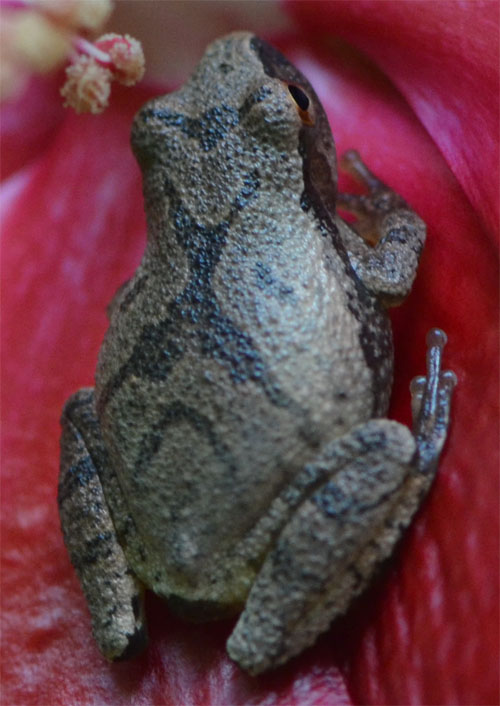
 Pseudacris crucifer (spring peeper) waiting for prey on a flower in the woodland garden. August 2011.
Posted in Interesting | Leave a Comment »
It’s labor day and the weather isn’t half bad actually – the sun has been able to penetrate the cloud cover and we got a nice beach day out of it on the bay. Ever since Irene hit, however, there is a distinct fall feel and smell in the air – it’s much colder at night and the leaves have started coloring to a distinct rusty tint, and many have let go and fallen to the ground. I’m not sure if this is a tropical storm induced fall (salt spray and wind as the cause?), or if this is the normal course of events regardless of the storm system that went by. Some of the osprey chicks are still around, and the hummingbirds are visiting the feeder daily, still. This time last year they had departed for more southern locales. The turtleheads and asters have not started blooming yet, either. The butterflies are no longer around – I fear that Irene tore them to shreds, but I hope that some of them made it around the eye to safer ground. I’m not quite ready to let go of summer but as usual the planetary clock does not care.
Posted in Rants & Raves | Leave a Comment »
Irene hit Cape Cod on Sunday August 28. It was mainly a wind event, taking with it branches and leaves of the white oak and black locust trees. The latter (Robinia pseudoacacia) were decimated, in fact. The trees look like bare pencils with some remnants of the compound leaves. One specimen – my favorite because it constituted one of the posts of my hammock, went down altogether later in the morning and hit the powerlines in a display of smoke and lightning. Well, that is the story told by my wife at least, as I was in the shower at the time.
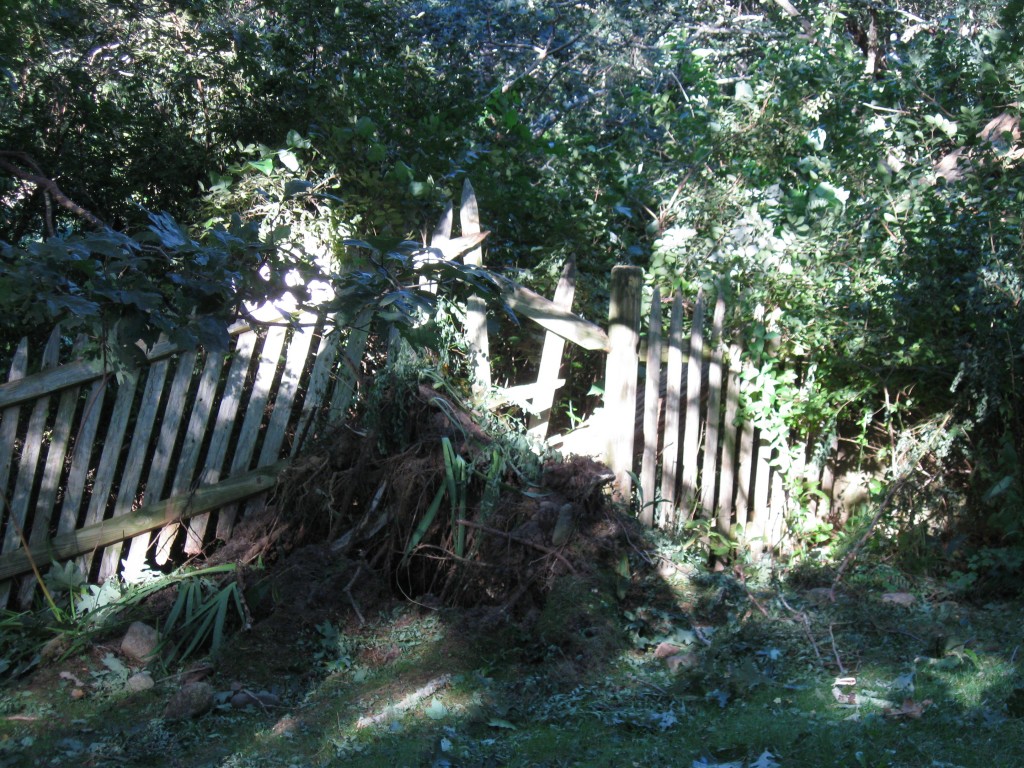
Although black locust trees are not quite native to Cape Cod, they can be seen everywhere. They have been planted places far and wide outside of the mountainous regions of the southeastern US. Although the trees can be targeted by woodborers, they tend to grow quickly and straight. This tree in the pea family produces fragrant racemes of milky white flowers in the Spring which can be smelled 40 feet below.
Now I am pondering what tree to plant next. Or is this too premature, especially since the trunk and rootball of this downed black locust are still amidst my destroyed fence?
The native plants did fairly well during the storm. Some of the taller swamp milkweed and cardinal flowers broke, but all in all I am happy with how the woodland garden fared.
I would have posted more of my thoughts on, and impressions of Irene, were it not for losing power for 10 hours. To add insult to injury, internet access was just restored today.
All in all, we were bruised but not broken. Irene was much more devastating elsewhere.
Posted in Interesting, Rants & Raves | Leave a Comment »
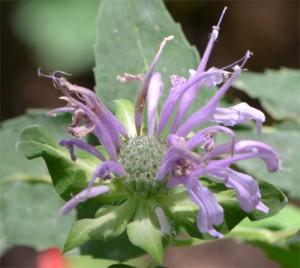 This perennial native to pretty much all of North America thrives in dry, rocky and low-quality soils, and there is plenty of that on the cape. This member of the mint family forms clumps that can grow 2 to 4 feet tall. It blooms with beautiful lavender flowers that closely resemble the flowers of a related species, Monarda didyma. These flowers are attractive to bees and butterflies. Wild bergamot starts blooming a little later than wild beebalm, but it continues to produce flowers throughout the remainder of the summer.
You are probably familiar with bergamot tea, which is brewed from the leaves of this plant.
I planted this perennial in less than ideal light conditions – wild bergamot thrives in full sun to partial shade, and I have them in almost full shade. Despite that, they still flower, but they have fallen victim to leaf eating insects and even some mildew, even though the species is fairly mildew resistant. I may move them to a better location in the fall.
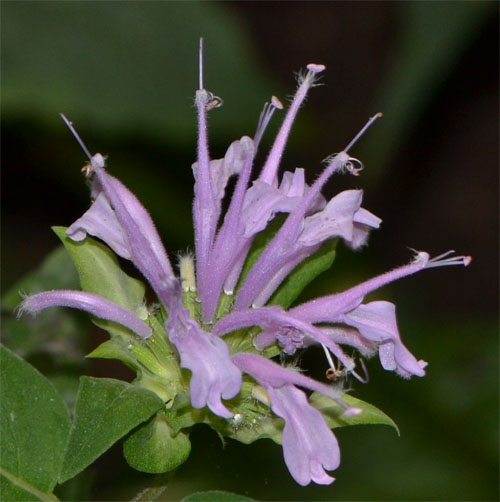
Monarda fistulosa Cummaquid August 10 2011
Posted in Edible, Flora, Plant bio | Leave a Comment »
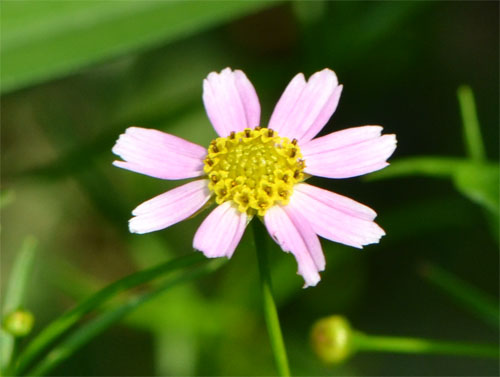
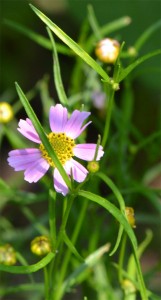 This species of coreopsis likes well-drained soil and full sun. It is the only coreopsis with pink flowers (most others are yellow). It is native to 8 states on the East Coast, including Massachusetts, and Nova Scotia. It is endangered or of special concern in most of these places. I have several cultivated coreopsis species, and I have these along Coreopsis rosea in mass plantings.
Coreopsis is a low-maintenance plant, you just need to water and wait. You can promote additional fall bloom by shearing the plants. You may want to do that anyway because this species of coreopsis tends to fall to the soil and look matted. The plants spread by rhizomes and self-seeding and they can form a dense ground cover, at the expense of lower growing vegetation. The seeds are also responsible for the plant’s other name – tickseed, as they resemble the small insects. The seed is a favorite of songbirds.
Posted in Flora, Interesting, Plant bio, Tips | Leave a Comment »
The sole reason for adding milkweed to my yard was to attract, and feed, butterflies. The orange flowered butterfly weed has been visited by scores of bees, flies and butterflies, and now that the bloom is waning it is evident that the plant has benefited as well – large seed pods are developing on the plant.
The swamp milkweed in the shaded area of the garden is pretty much done blooming too, and seed pods are also developing. It was a nice suprise to find monarch butterfly (Danaus plexippus) caterpillars feeding on the leaves, and some of them (the fatter ones) have started to hang from the leaves as if they are going to form a pupa any day now. The bright stripes of the larva may serve as a warning to predators, because they are poisonous or at the very least distasteful to birds: Some of the milkweed toxins build up in the caterpillar.
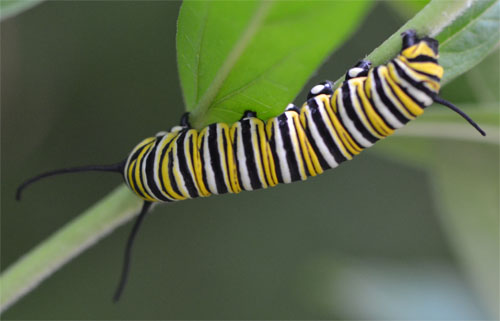
The monarch is the only butterfly that migrates both north and south (like birds do). But no single individual makes the entire round trip, as the individual butterfly only has a 2 month lifespan. Female monarchs deposit eggs for the next generation during these migrations.
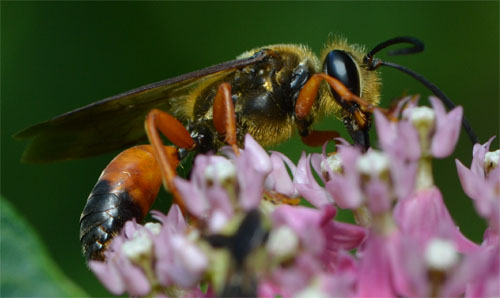
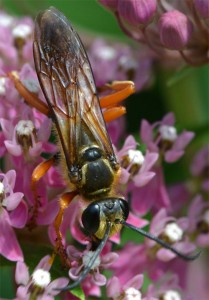 On the sunny side of the garden, the swamp milkweed plants are still blooming in full force, and they get visited by butterflies, flies, bees and wasps non-stop. The area looks like a fly-by feeding station. Some of the more frequent visitors are great golden digger wasps (Sphex ichneumoneus).
The females of these solitary wasps dig vertical burrows, with individual larval cells branching off horizontally. They provide each cell with a paralyzed insect (cricket or something along those lines), then lay a single egg inside. The paralyzed insect remains alive and must await becoming larva lunch when the egg hatches. The likes of “Saw” have nothing on what nature comes up with. The adult wasps eat nectar only, and they only hunt members of the grasshopper family to feed their offspring. Butterflies and other non-grasshoper-like insects are perfectly safe. These wasps are excellent pollinators, and I am only too happy to have them in my yard (even though I prefer a little distance between me and these large insects).
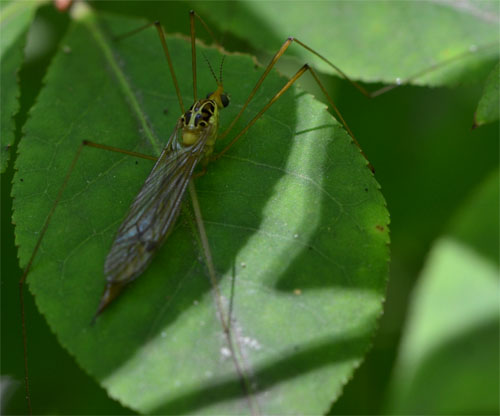
Crane flies seem pretty innocuous, and the adults certainly are – they feed on nectar, or nothing at all, and just live long enough to mate and reproduce. The one in the picture is likely Nephrotoma ferruginea, although that is an educated guess – there are several different species living in Massachusetts, and identifying these insects correctly may take a PhD in entomology and good magnifying glasses. The larvae of the crane flies live in the soil and sod and eat the roots of plants and grasses, and they can do some real damage to the lawn.
Posted in Fauna, Flora, Interesting | Leave a Comment »
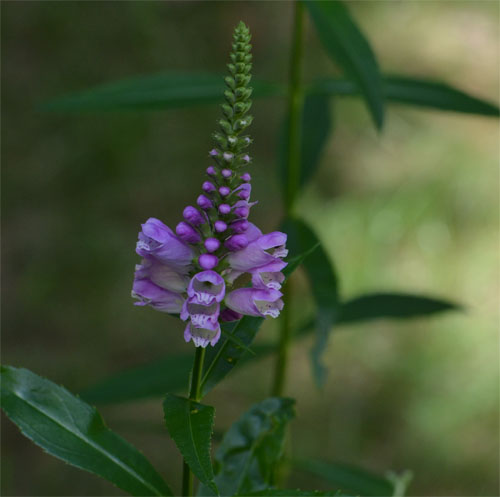
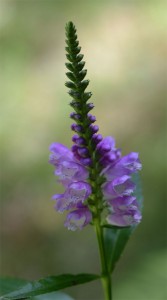 This plant is a perennial in the Mint family, native to the eastern United States.
At first, I thought the name to be quite deceptive – Physostegia virginiana can be quite agressive under the right circumstances. It spreads rapidly by the roots or stolons, when left unchecked. Luckily those roots are just below the surface and you can easily control the expansion. The plants in my woodland garden have moved into new territory somewhat, but not in the agressive way that is supposedly so chararteristic of this plant – maybe the circumstances are not quite right in terms of light requirements. Back to the name: Apparently obedient plant gets its name from the fact that if you move an individual flower back and forth on its axis, it will stay in the position you put it in. I am not sure who, besides a child, would come up with such an experiment, but there it is.
The plant likes sun to partial sun, and does well with both drought and poor drainage. The spikes of pink flowers are a good nectar source for bees (bumblebees in particular), and butterflies. The hollow square stems can grow 4 to 5 feet tall, and can easily get bent or blown over in heavy rain or wind. I forgot to stalk my plants this year, unfortunately, and the rains of the last few days have flattened some of the plants.
Posted in Flora, Plant bio | Leave a Comment »
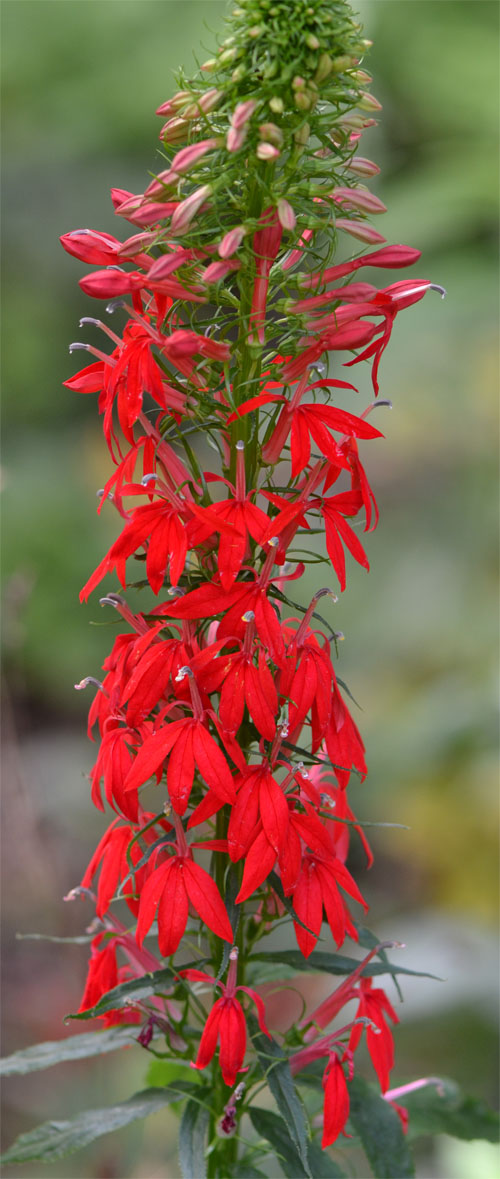
Lobelia cardinalis in full glory, Cummaquid August 6 2011
Posted in Flora | Leave a Comment »
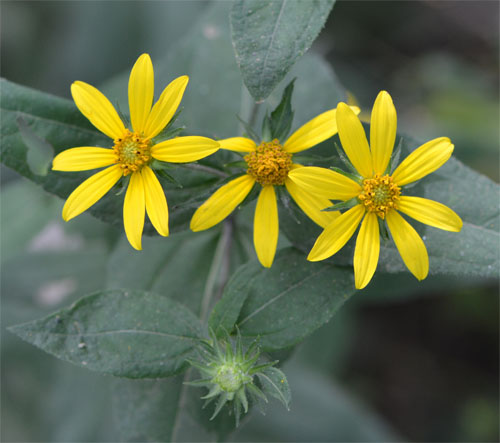
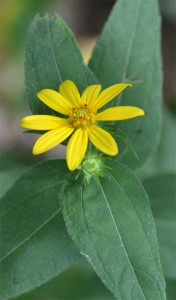 This perennial native to eastern North America prefers dry open woodlands, and does well in Cape Cod soil. The plant reproduces by seed, but it can form dense colonies from its rhizomatous root system. It can actually be fairly agressive and crowd out other plants. I can be somewhat messy – I’ve had to stalk some of the plants this year because heavy rain and wind easily flattens the stems (the wet weight of the flowers is most likely contributing to this). I’m hoping they’ll eventually grow dense enough to keep one another facing upright. The flowers are visited by a series of insects and the seeds are a favorite of birds. Rabbits can take a liking to the foliage, but in my yard they have found tastier fare and have left the woodland sunflower be, at least so far.
Posted in Flora, Plant bio | Leave a Comment »
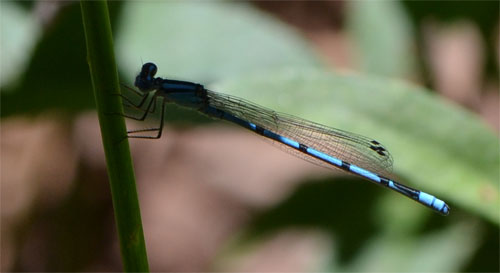 Despite the fact that the nearest pond is at least a mile or so away, I get many damselflies in my yard. Water is important because damselflies mate over water, either in flight or perched on reeds or other plants. After the mating ritual, the female damselfly lays her eggs on submerged vegetation. The eggs hatch and nymphs emerge. These damselfly nymphs eat other bugs that are unfortunate enough to get too close. The nymphs molt several times before they leave the water and become adult damselflies.
The adult damselfly has four wings that fold over the back. The male bluet displays the characteristic blue color while the female is gray or brown. The adults feed on insects, which they catch and eat midflight.
Posted in Fauna, Interesting | Leave a Comment »