Feeds:
Posts
Comments

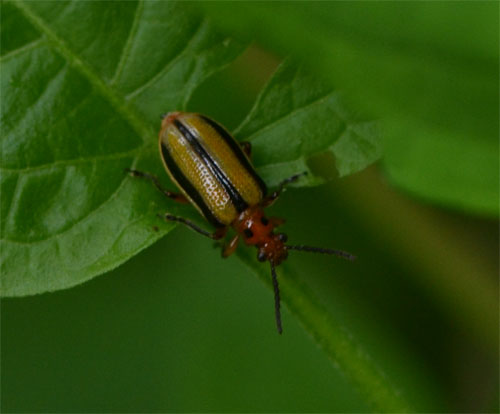
The three lined potato beetle (Lema trilineata) has been pushed out of the limelight by the colorado potato beetle, wich moved eastward from the Rockies in the 1850s. The larvae of these species do quite the job on cultivated potato, tomato and eggplant foliage. I grow none of those in my garden, and none of my neighbors do either. Lema trilineata prefers to feed on the flowering plant species of the Solanaceae family, which contains cultivars and edibles such as potato, pepper, tomato, as well as poisonous plants such as the nightshades. Since I have a fair amount of climbing nightshade in the yard, I can see why this beetle would be present. In the picture, Lema trilineata is resting on jewelweed leaves, but Solanum dulcamara is all over the place.

three lined potato beetle Cummaquid July 1 2011

Lema trilineata Cummaquid July 2011

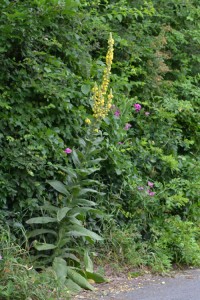
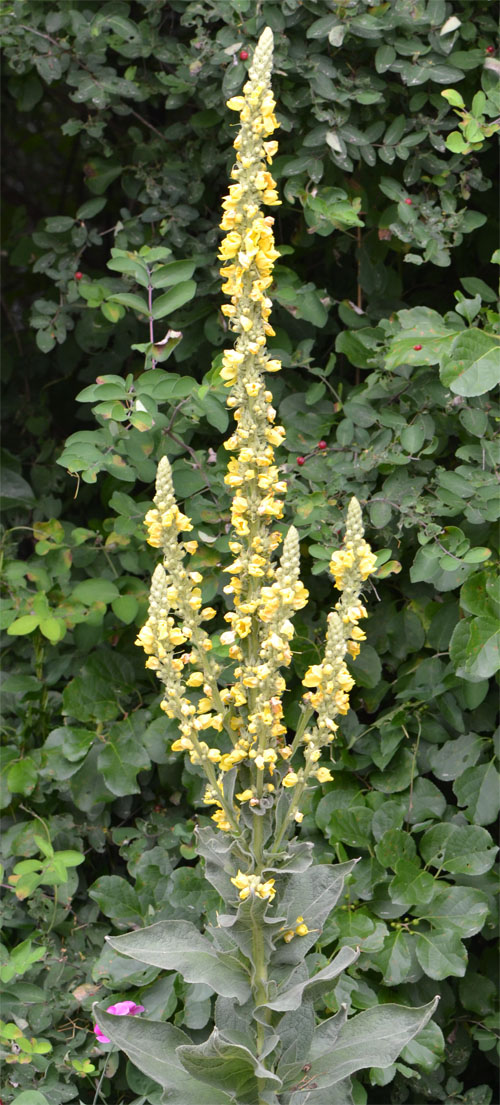
common mullein Cummaquid July 1 2011The leaves of this European plant are a grayish-green color with soft, velvety hairs. Common mullein is a biennial. In its first year, it grows leaves in a basal rosette It sends up a flower stalk and produces seeds in the second year.  Most of the flowering mullein plants I’ve seen have been a respectable 3 to 5 feet tall.  The specimen in the picture measures 8 feet tall!

Verbascum thapsus produces many seeds (between 100,000 and 180,000 per plant) that can remain viable for a hundred years or so, but it is rather picky about its environment. It likes sun, and seed will not grow if it is covered in shade. The plant does not like to get crowded, and you will most likely find it in open spaces in barren ground. The quality of the soil itself does not matter much – it thrives in poor sandy soils. Common mullein was first introduced into the U.S. in the mid-1700’s, where it was used as a fish poison, in Virginia. It is now firmly established in the eastern US. The plant was also used as a medicinal herb, as a remedy for coughs and diarrhea and a respiratory stimulant for the lungs when smoked. A methanol extract from common mullein has been used as an insecticide for combatting mosquito larvae.

mullein July 1 2011

A rather tall order of common mullein July 1 2011

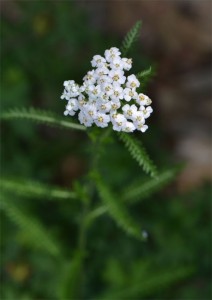
yarrow July 1 2011

Yarrow, July 1 2011, Brewster

There is some disagreement on whether this plant is native or not. Achillea millefolium is a plant omnipresent in Europe and Asia, and most think that it was introduced in North America in early colonial times. Others seem to think that there is a native species, although it is indistinguishable from the Eurasian plant. I’ll consider it an invasive.

Yarrow likes sun, but does ok in partial shade. Yarrow is drought tolerant and is generally resistant to insects and disease. Yarrow has white flowers, but you will find yarrow cultivars in many colors.

Yarrow has been known to humans for a long time: Yarrow plant material was found  in a 100,000 year old Neanderthal burial site in Iraq. Yarrow is widely used as a medicinal plant – it contains well over a hundred biological and chemical compounds. Think of a condition and you may find an application for yarrow. Here’s a short list:

In a topical application, yarrow stops bleeding, contracts skin tissue, inhibits bacterial growth, heals tissue, acts as an anti-inflammatory, and acts as an anesthetic.  

When used in a tea, it raises the body temperature and makes you sweat. As a tonic it stimulates digestion, lowers blood pressure, and slows your heartbeat.

The plant is also edible – as mentioned earlier you can drink it as a tea or tonic, and the plant has been used to flavor beer, wine, and soft drinks. The leaves can be used as a seasoning . Young leaves can be boiled or added to salads.

As with anything, moderation matters!  Over-exposure to yarrow can make you sensitive to light, although studies have shown no appearance of fangs.  Some individuals are allergic to the plant and will get rashes when handling yarrow.
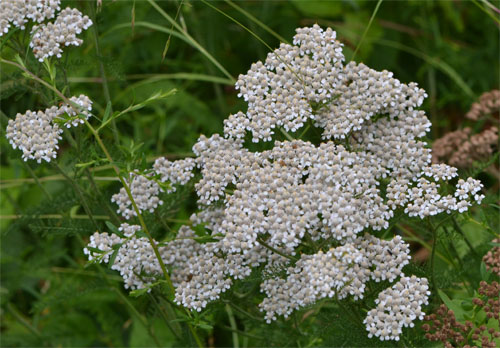
yarrow July 8 2011

Yarrow plant in Barnstable, July 8 2011
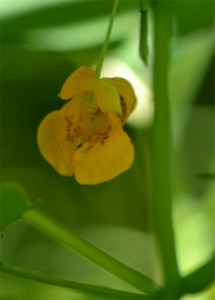
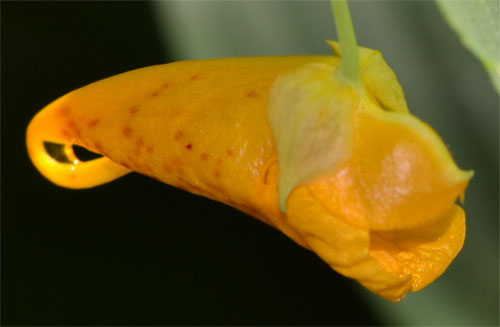
jewelweed flower July 1 2011This annual plant goes by many names, but jewelweed or spotted touch-me-not seem most appropriate. Dew often gathers in glistening drops on  the flowers, and it produces long seed capsules that split and propel the seeds when touched. Jewelweed likes it moist and is at home in woods and on streambanks. The flowers are frequently visited by hummingbirds.
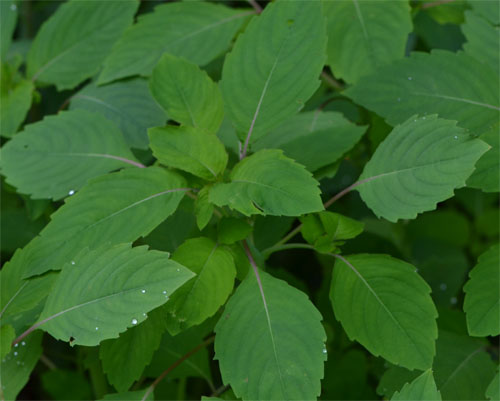
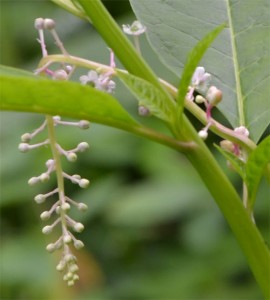
The plant is probably best known as an effective remedy against poison ivy.  You can crush the hollow stems and rub the sap on the skin exposed to poison ivy. Symptoms will not appear or will be much less troublesome. The sap neutralizes the urushiol, and you will no longer spread the poison ivy oil by rubbing or scratching. Additionally, jewelweed  is effective against poison oak, bug bites and razor burn. The sap is also used for acne, heat rash, ringworm and many other skin disorders. Some folks make and sell jewelweed soap, and you could try this yourself – there are many tips and guides online.

Impatiens capensis has been exported to Europe and is now established in several countries.

flower of the jewelweed July 1 2011

jewelweed foliage July 1 2011

pokeweed July 1 2011Phytolacca americana is a tall fast-growing perennial, native to the eastern US. Currently pokeweed is starting to show greenish-white flowers, and in late summer and fall the plant will produce dark red berries that grow even darker over time. The juice of the berries was once used as an ink substitute, and to add color to wines. Native Americans used the berries to color their horses. Most parts of the plants are extremely poisonous to mammals and humans, especially the root, berries, and flat seeds within those berries. Birds can eat the fruit because they pass the seeds intact.
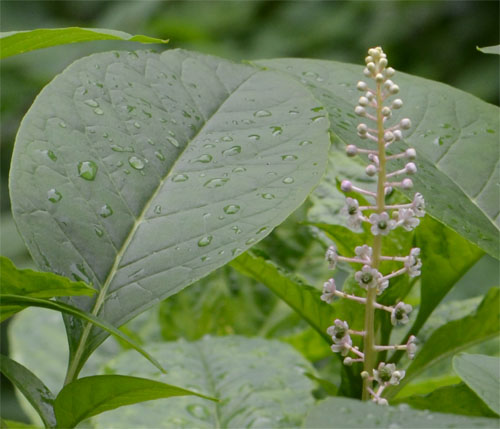
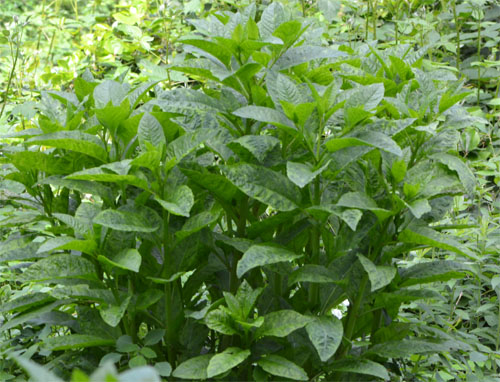
Despite the poisonous nature of pokeweed, fresh young leaves and shoots may be cooked and consumed. Those same greens are commercially available as a canned vegetable known as poke salet or poke salet greens – you will still see it in the south and in places like California where many dustbowl victims migrated. Pokeweed definitely is a depression era or poor folks’ vegetable.

pokeweed July 1 2011

Flowers appearing on the pokeweed July 1 2011

I will add some recipes below, but try these at your own risk: If taken internally, pokeweed is a slow acting but very violent emetic. Vomiting usually starts about 2 hours after having eaten the plant. Poisoning will result in purging, spasms, and convulsions. Death can occur due to paralysis of the respiratory organs.

Now, are you still ready for the following?

Pokeweed salad

  • Use pokeweed leaves that are no more than 3 or 4 inches tall. Avoid any leaves that have a reddish tint.
  • Wash the leaves well.
  • Steam the leaves with some water and salt for 30 minutes.
  • Season with melted butter and vinegar, if desired.
  • Garnish with a couple of slices of hard boiled eggs.

Bacon and pokeweed scrambled eggs

  • Gather young 3 to 4 inch tall pokeweed leaves.
  • Parboil leaves for three minutes, then drain.
  • Parboil a second time and then drain again.
  • Cook until tender.
  • Fry three strips of bacon, a chopped green onion and then add the drained greens. Get this hot and then add four eggs to make a scramble.
pokeweed June 24 2011

pokeweed in the backyard back in late June, 2011

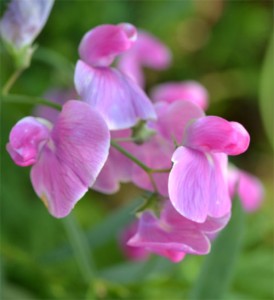
marsh pea Keveney lane Barnstable July 3 2011This native member of the pea family is fairly abundant in wet thickets and low lying areas of the bay side on Cape Cod. If you take a bike ride through the coastal areas of Yarmouth and Barnstable you will see the pink and blue hues of Lathyrus palustris.
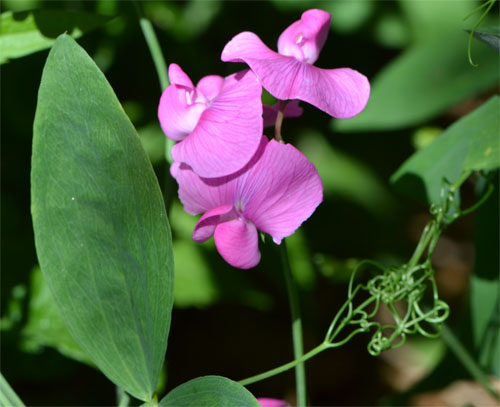
The seeds are edible – you can shell and cook them like you would ordinary peas. However, while no record of toxicity have been found the seed contains an amino acid that can cause a severe disease of the nervous system, but only if eaten in large quantities. So, for you and me the usual amount would provide nutritious sustenance, but over-eaters like Joey Chestnut are advised to stay away from this legume.

marsh pea Barnstable July 3 2011

marsh pea Barnstable July 3 2011

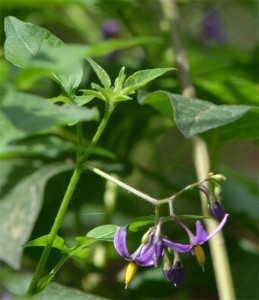
climbing nightshade July 1 2011For some reason I always associated this plant with poisons brewed back in medieval times, but that would have been deadly nightshade (Atropa belladonna). This plant from Eurasia is to be found all over the cape in moist and semi-shaded thickets and brush. It is all over my yard as well.
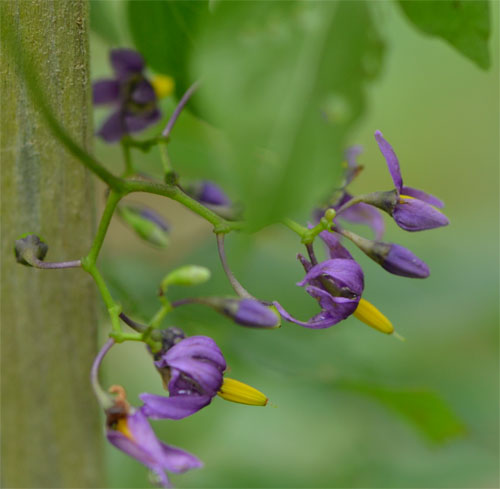
Although it may not be the killer of lore, it does have some poisonous qualities. The steroidal alkaloids have been known to poison cattle and sheep. There are more alkaloids in the green immature berries. Ripe berries don’t seem to be as bad. The plant is used widely in herbal medicine as a remedy for allergies and herpes. However, the plant should still be approached with some caution: Excessive application or ingestion of this plant’s materials can lead to paralysis of the central nervous system, a slowing down of the heartbeat or respiration, a lowering of the body temperature, vertigo, convulsions, delirium, and ultimately, death.

The flowers are quite beautiful, and that may be a reason to keep the plant around. Birds also feast on the berries – they don’t seem to suffer ill effects (can you imagine a bird with vertigo?). Keep your pets and kids away, and wear gloves when touching the plant – the alkaloids are also present in the leaves.

climbing nightshade July 1 2011

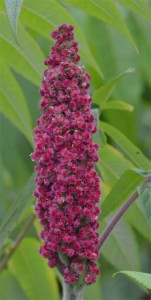
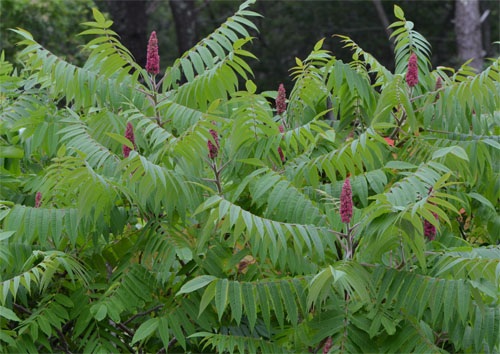
staghorn sumac July 3 2011

fruit of the staghorn sumac Cummaquid July 3 2011

There are some 250 different flowering plants in the genus Rhus (currently, as new research may lead to breaking up this group into smaller segments), but unfortunately we only seem to remember the infamous ones: Poison ivy (Rhus toxicodendron), poison oak (Rhus diversiloba) and poison sumac (Rhus vernix) can be quite memorable. They all contain urushiol and cause severe allergic reactions in many individuals.

Staghorn sumac is a large (10 feet and up), open-spreading shrub or tree with a flattish crown. The branches look like the antlers of a deer. The plants are currently adorned with red velvety looking fruit. The plant is native to southern Canada and the eastern US. Back in the day native American Indians made a lemonade-like drink from the fruit. Tannery workers used the tannin-rich bark and foliage as a tanning agent. All parts of the plant can be used as a dye or dye fixing agent.

Sumac can grow rapidly, but requires direct sunlight to persist. It is stubborn – I’ve cut back a staghorn sumac stem in falls past and every year it has come back to sprout a 10 foot stem. Eradication, if that is your choice, may involve getting rid of the root stock. However, that is not my intent since the plant has a place and role in the open oak woodland.

staghorn sumac Cummaquid July 3 2011

Rather than using the weed wacker, one might try drinking the shrub away. Really – the following recipe is an adaptation of Steven A. Krause’s Wines from the Wilds:

Fruit should be gathered soon after turning red, as the longer the remain on the bush the more tasteless they become. Fully ripe staghorn sumac should taste sour. Do NOT extract juice with boiling or hot water, or else too much tannin will be extracted and will result in an astringent and bitter wine.

  • 5 lbs ripe staghorn sumac berries
  • 3 lbs finely granulated sugar
  • 1 gallon water
  • 1 crushed Campden tablet
  • 1 tsp yeast nutrient
  • 1 packet Lalvin 71B-1122 (Narbonne) or RC212 (Bourgovin) wine yeast

Wash to remove dust and insects. Put clusters in container, cover with water and mash or crush the berries with 4″ x 4″ piece of hardwood. Strain juice into primary through clean muslin to remove plant hairs and pulp. Add sugar, crushed Campden and yeast nutrient and stir well until all sugar is dissolved. (NOTE: Sugar could be dissolved in boiling water beforehand but must cool to room temperature before pouring over sumac fruit.) Cover primary and set aside 12 hours. Add activated yeast, recover and stir daily. After 14 days of fermentation, transfer to secondary, and fit airlock. You should have more than one gallon of wine, so use a one-gallon secondary and a 1.5-liter wine bottle fitted with a #2 bung and airlock. The wine in the smaller secondary is what you will use to top up the one-gallon secondary. Rack, top up, and refit airlock every 30 days wine is clear and drops no sediments during 30-day period. Stabilize, sweeten to taste if desired, refit airlock, and set aside for 10 days. Rack into bottles and age at least one year before drinking.

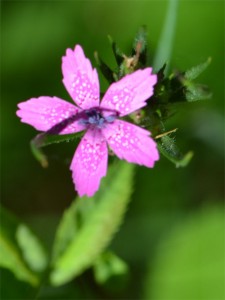
deptford pink July 1 2011The common name of this pretty little annual or biennial flower comes from the town of Deptford in England where the plant grew abundantly. Deptford has long since been incorporated into larger London, and any pasture or woodland has been paved over or covered in concrete. This plant is native to most of Europe and can now be found in North America. It is often cultivated because of its nice pink flowers. I found a few of these plants in the Brewster Natural History Museum, near the marsh.
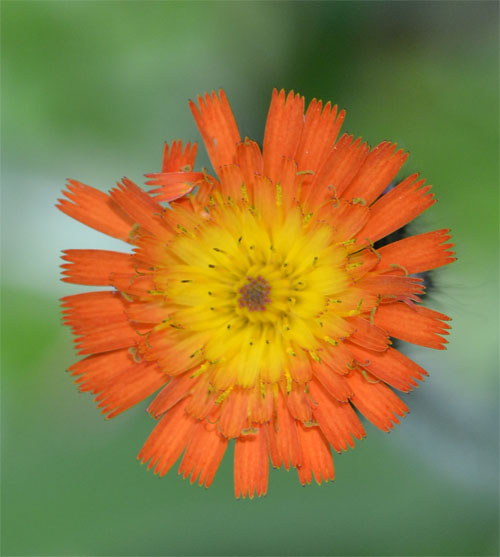
Orange hawkweed was first introduced from Europe into New England because of its attractive flame-colored flowers – it is a beautiful plant: Orange hawkweed has matted hairy leaves and handsome flowers, each about an inch in diameter and usually red on the margin, merging into an orange-colored center. The flowering branches, or shoots, grow from a few inches to two feet in height. They are leafless and covered with stiff black hairs. Problem is that once again our livestock is losing out – Hieracium aurantiacum is an aggressive competitor of pasture and range plant species, and it is unpalatable to our grazing cattle and horses.

orange hawkweed July 1 2011

Orange hawkweed at the Museum of Natural History - accident or intended? July 1 2011

« Newer Posts - Older Posts »