For the past two months I have been on a bug killing spree. I am guilty of being a very non-eco friendly person lately in my treatment of bugs and I am not happy about it.  I would definitely never make it in one of those religions where you’re forbidden to kill living things. First I committed premeditated murder on the ants that kept appearing daily in an upstairs bathroom (why they did not choose the downstairs guest bathroom is beyond me). They were getting stepped on anyway I figured, I was constantly picking up little mushed bodies. The live ones were way too fast to try and “save” or put out the window. The ants must have been attracted to the water in the plumbing, that’s why they were there. I broke down and put some of those ant traps in the room (Wired Magazine needs to do one of their articles on what is in those, like they recently did with Liquid-Plumr.) Of course the ingredients were not printed on the ant trap package, so god knows what chemicals I am fouling the planet with, but I really didn’t want to scare my guests with an ant farm in the bathroom. The ants seem to have gone away, but then again it might just be that the thirsty ants are gone. If they were there for the water, it’s possible those little black boxes would have been of no interest to them anyway. I only hope I did not kill any ants outside, or any more than I needed to. Ok, just checking out the “Hot Shot Ant Bait” site and this is what I did by using those:
- Kills ants in 24 hours!
- Destroys the entire colony, including the queen
- Unique attractant gets ants to the bait fast so they die fast
- The bait food is carried back to the nest to kill the queen and destroy the entire colony
I am seriously one big hypocrite. Not only did I kill the ants in the bathroom, I pretty much massacred thousands of them. Great. All I wanted to do was stop them from traipsing through my bathroom…
A second type of creepy-crawly that I unenthusiastically smooshed a few of is the Wood Roach. I originally saw one of these guys in a friend’s house in Yarmouthport. His home was very clean, so I assumed it to be more of an “outside” bug than an inside pest and I was right. These animated critters can be found in any wooded area, and on occasion they get inside but it’s really not where they want to be. In a blog from a real estate company “Peters Real Estate” based in Eastham, I found some enlightening info on the topic of these “country roaches”:
It is not interested in human food and does not carry any diseases or contaminants. It lives outdoors, especially in woods or garden areas.  Their crime? They resemble an immature cockroach quite closely when they are not moving, being tan and flat with wings that appear to be shell-like when closed. In fact, they are referred to as the “spotted roach” because of several blue dots visible through a magnifying glass on their underside, or the “pine roach” or “wood roach” because of their native habitat. They are NOT cockroaches (German roaches) and, in fact, have more in common with moths than their distant German cousin.   There is no chemical method of removing (exterminating) wood roaches because of their outdoor habitat.  The old adage, “Where there’s one, there’s more” is not true indoors for these outdoor bugs.
This info was great to find, and indeed these guys are kind of cute. However, I don’t particularly like having the occasional visitor in the house - I don’t want to scare my guests with these roach impersonators!
The third and most recent country bug I have dealt with is what I think are “Cluster Flies” (ew). I live in an old-ish house which is by no means air tight, the cellar, for example, has a partial dirt floor. Occasionally a critter gets in. Either one of those critters died creating a smorgasbord for a lady fly to lay her eggs, or as a fellow Cape Cod resident mentioned to me today, “it’s just the season”.  I hung some fly tape for the week they visited me but the flies were much more interested in hanging out on cellar windows – not being let out – just hanging out À la “Amityville Horror”.  These I have no problem killing, they do carry all manner of disgusting diseases. Flies are great – outside – they pollinate plants and clean up decomposing matter. I wouldn’t recommend them as indoor pets though, they carry up to 100 infectious diseases. I have to say any killing I did was self defense. Here are some “fly facts” that I found online and of course feel compelled to share:
- House flies’ feet are 10 million times more sensitive to the taste of sugar than the human tongue
- Bush flies remain joined together for 80 minutes when mating
- Despite years of trying, no researcher has ever been able to teach flies anything – fish learn, ants learn, snails learn, cockroaches learn, even worms learn … but never flies
- A coffin fly can live for up to a year inside a sealed coffin – it can produce many generations who all happily feed off the dead body
Skin crawl- inducing stuff for sure. But we do have to remember this fact: Ecologists say that if all the humans were to suddenly vanish, the environment of Earth would improve, but if all the insects were to suddenly vanish, it would be a disaster.
(Note: to anyone who’s come across this article by Googling how to get rid of pests and you live in the country, I highly recommend NEVER using one of those foggers. Although you may get rid of the bugs initially, what you will succeed in doing is killing the good bugs as well as the bad, ie there are a lot of good bugs that eat the “bad†bugs. Bugs are an inevitable part of living in a place that’s not covered in concrete; for all the creepy-crawlies you see just outside your home there are probably thousands more you never see. Part of me wonders if that week-long fly problem had something to do with killing a nearby ant colony that may have kept them in check. If you have an infestation that’s putting yourself or your family in danger, I suggest an eco-friendly pest control professional.)
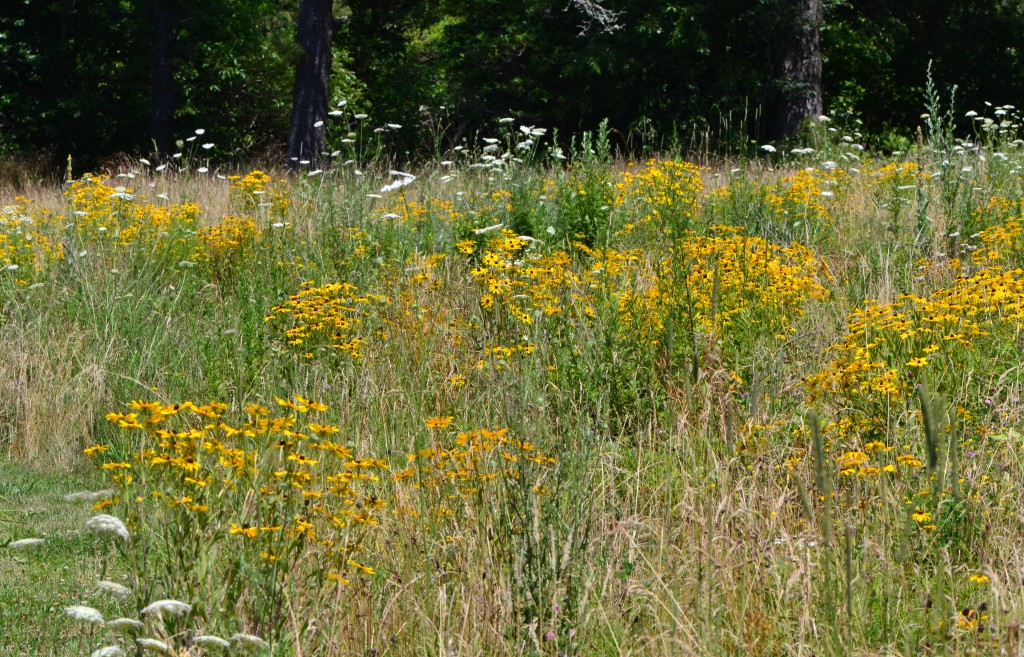
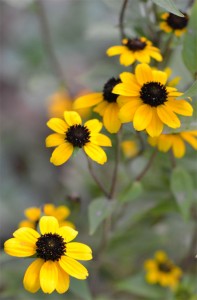 I just added this plant to the edge of my woodland garden. Browneyed susan is a biennial, so I am hoping that it will self-seed in that particular area. That may be wishful thinking on my part, because the plant would do better with a bit more direct sunlight. However, other folks have had no problem with Rudbeckia triloba maintaining a presence in their yard, from self-seeding alone, in less than ideal circumstances. Right now it is displaying a mass of beautiful showy quarter sized flowers. The blooming period lasts for a month or two from July through August. Triloba points to the three-lobed leaves, but the plant also displays 5 and seven lobed leaves. Seems to me the naming convention folks were somewhat quick to pull the trigger…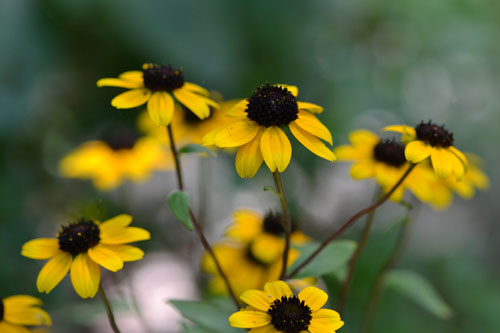
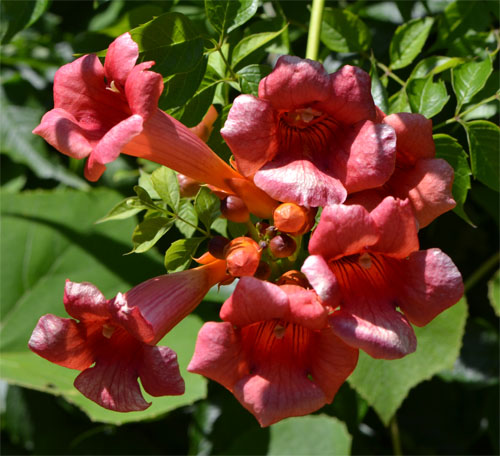
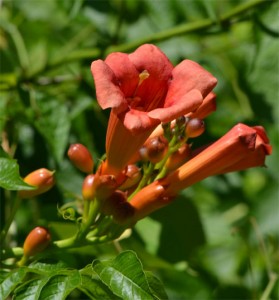 This vine is native to eastern North America and can be found in roadside hedges here and there on Cape Cod. The highway beautification crews up in the Boston area use this vine to cover the sound barriers along Route 93. It is often planted for its attractive, reddish orange, and sometimes yellow flowers. It does not need encouragement however, as this vine is extremely agressive and difficult to eradicate once established. Older plants have a massive root system that can undermine walkways, roads and walls. It will quickly climb up any support structure it can find, even if that means enveloping your house. It has its uses though – The dense growth makes it useful for erosion control.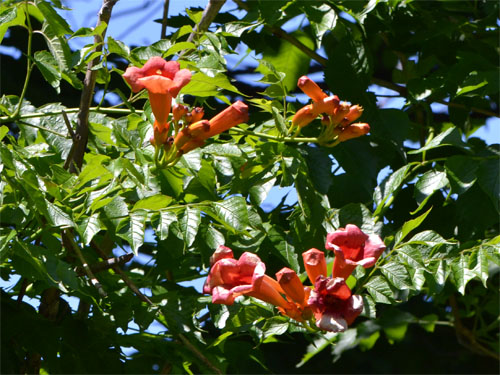
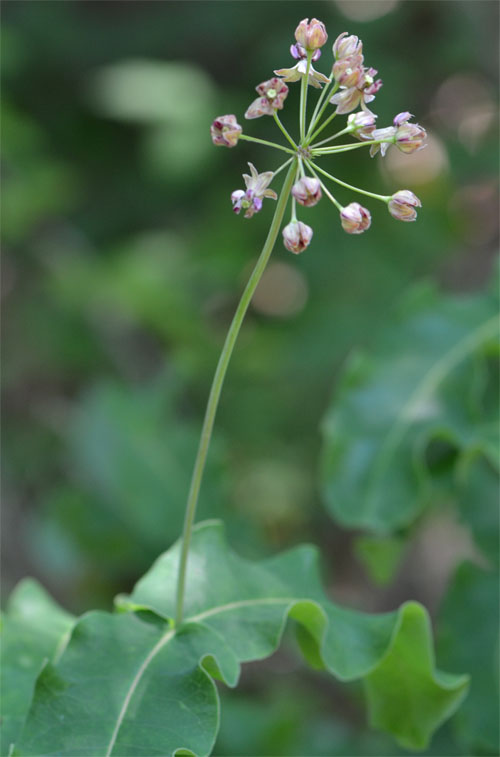
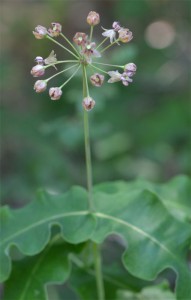 Asclepias amplexicaulis is also known as sand milkweed and grows to 3 or 4 feet in height. It has pink flowers like the common milkweed, but the flower cluster is less dense. The distinguishing feature of the plant, however, is the way the leaves are curled or whorled. This milkweed prefers dry soil conditions, and grows best in full sun to partial shade. Asclepias amplexicaulis blooms from mid June to early July, on Cape Cod. It requires dry, sandy soil, is rhizomatous, and drought tolerant. This plant attracts bees, ants, and butterflies.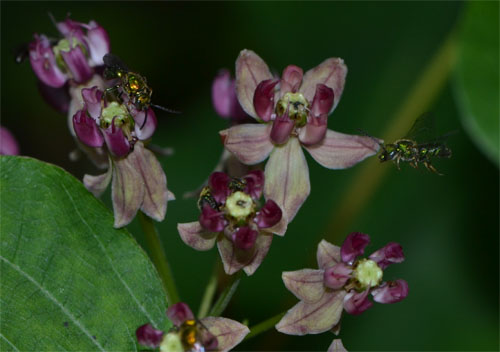
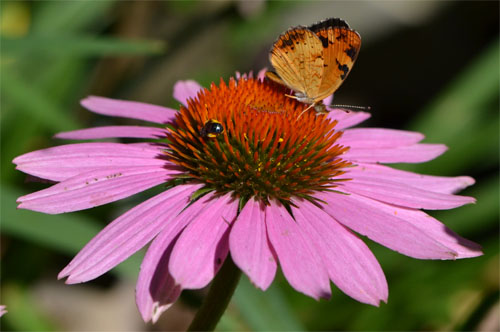
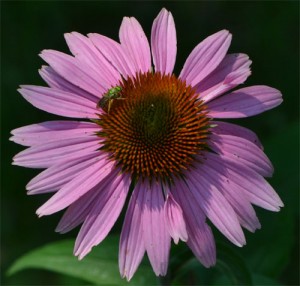 I’ve known about Echinacea, the herbal supplement, since childhood. In Europe it’s been an essential ingredient of several cold and flu medications. Most of the research on the uses and benefits of this plant was done in Europe, Germany in particular. Although there remains some scepticism about the validity of the studies, researchers contest that Echinacea stimulates cells responsible for fighting all kinds of infection. Unlike antibiotics, which directly attack bacteria, Echinacea helps our own body attack bacteria, viruses and abnormal cells, including cancer cells. There are claims that Echinacea increases the number of immune system cells including anti-tumor cells, promotes T-cell activation, stimulates new tissue growth for wound healing and reduces inflammation in arthritis and inflammatory skin conditions. In the United States, we have relied much more heavily on antibiotics, and Echinacea is largely relegated to second tier shelves in pharmacies, although that has changed somewhat over the last few years.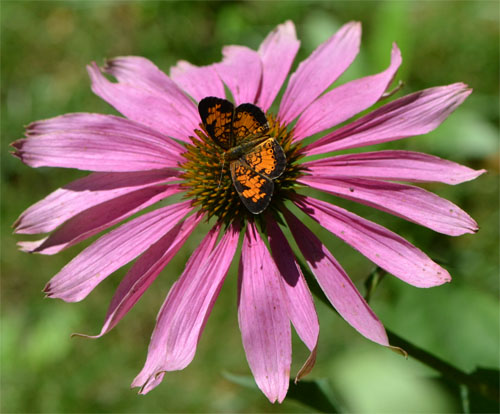
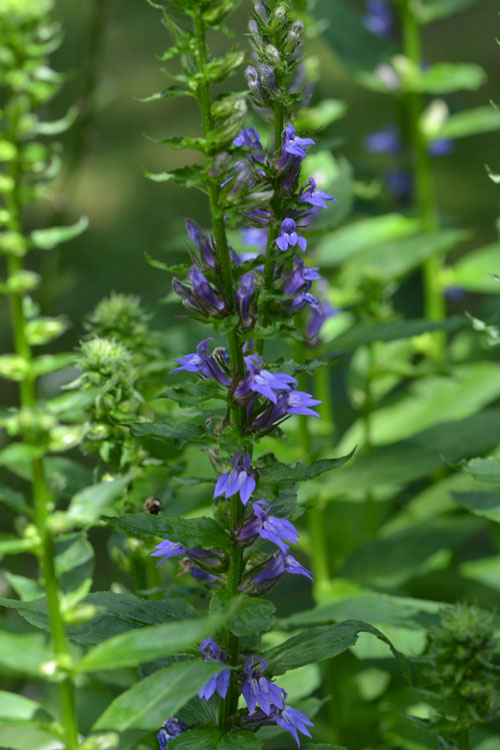
 Lobelia siphilitica is another short lived perennial (2 to 3 years) native to eastern and central Canada and US. It grows 3 to 4 feet tall, and produces blue flowers from August to October.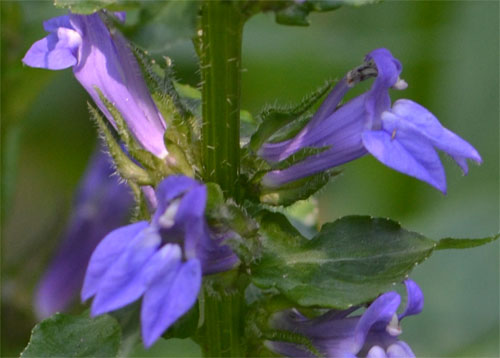
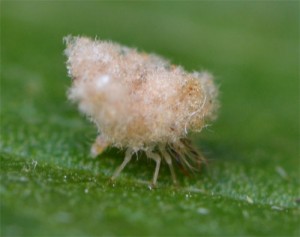 The diversity of the fauna in my backyard never ceases to amaze me, the other day I discovered a bug that was so well camouflaged, I thought it was a breadcrumb or a piece of lint. I was brushing it off my shirt when I realized the breadcrumb had legs. Hours of nature show watching alerted me to the fact that this was probably an insect of some sort, regardless of its appearance and asymmetrical shape so I picked it up off the ground and examined it closely. Sure enough, it was a bug – a lacewing larva or “aphid lion”. Some lacewing larva use pieces of material such as insect bodies or secretions or even grains of sand to make them appear to be those objects or at least hide their true identities. It’s pretty amazing, their camouflage is not their own body but in some cases a costume made out of another insect’s parts. We got some photos of this fascinating bug that is a perfect example of nature’s strange and powerful capacity for adaptation and survival.
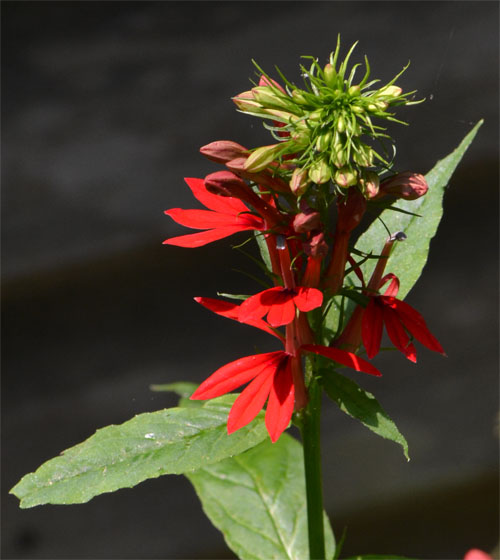
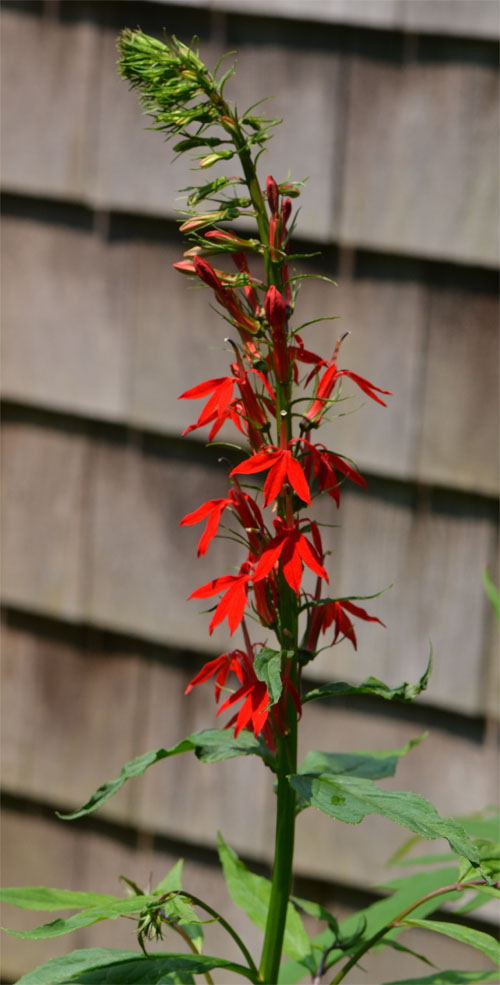
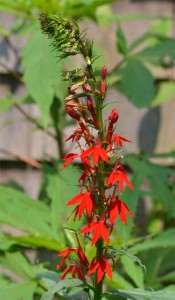 Lobelia cardinalis produces spikes of bright fire red flowers for about a month. I added these to the woodland garden to attract hummingbirds, and so far they have not disappointed. These little avian wonders have a smorgasbord to select from, with bee balm and a nectar feeder to boot, but they make the extra effort to visit these flowers. In the wild it is pollinated by the ruby-throated hummingbird (Archilochus colubris).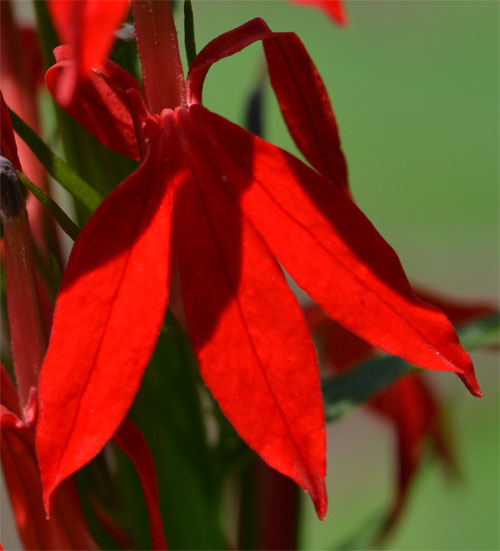
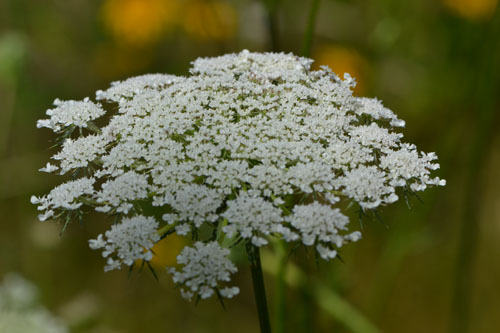
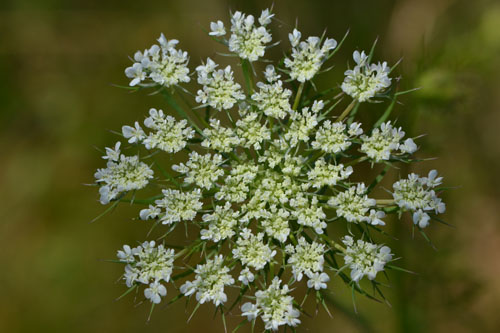
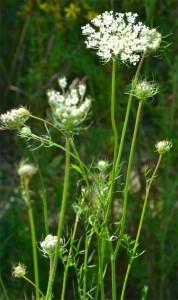 The common name of this natively European plant comes from an old tale about Queen Anne, a fervent lacemaker, who pricked herself on a needle, causing a drop of blood to fall on the lace. The flower structures of the plant are very much lace-like. In some of the flowers there is indeed a tiny blood red or dark brown center. The other common name, wild carrot, is somewhat more appropriate – this plant is the original carrot, the forefather of the cultivated root on our dinner plate! The use of various types of wild carrots goes back about 5,000 years. Historians think that the modern orange-colored carrot was cultivated in the 16th century in the Netherlands. It is the Royal House of Orange, after all.